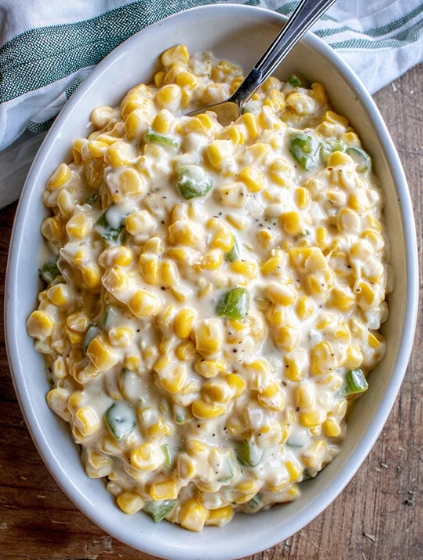
In the culinary architecture of side dishes, “Jalapeño Creamed Corn” represents a sophisticated Biphasic Suspension. We are not merely heating vegetables; we are engineering a Starch-Stabilized Dairy Matrix designed to encapsulate individual kernels of sweet corn. This formula utilizes the Capsaicinoid Heat of the jalapeño as a chemical foil to the dense lipids of the cream, resulting in a balanced, high-viscosity profile that resists thermal separation.
Project Specifications
Success in this build requires precise management of “Amylaceous Thickening.” We must optimize the release of natural corn starches to complement our added dairy binders.
- Prep Time: 15 Minutes
- Inactive Time: 5 Minutes (Matrix Setting)
- Cook Time: 20 Minutes
- Total Time: 40 Minutes
- Servings: 6-8 Units
Detailed Cost Estimate (USD)
| Cost Driver | Role | Est. Cost |
|---|---|---|
| Sweet Corn (Fresh or Frozen) | The Starch Foundation | $4.00 |
| Heavy Cream & Cream Cheese | The Lipid Emulsion Matrix | $5.00 |
| Fresh Jalapeños | Capsaicinoid Infusion | $1.00 |
| Parmesan AOP | Umami Texture Binder | $2.50 |
| Total Estimated Cost | $12.50 | |
The Ingredient Architecture
The Starch Foundation
6 Cups Corn Kernels: If using fresh corn, “milking” the cob provides Endosperm Starch which acts as a secondary thickening agent. Frozen corn provides a consistent Cellular Integrity.
The Lipid Emulsion Matrix
1 Cup Heavy Cream & 4oz Cream Cheese: A high-fat dairy blend. The heavy cream provides the liquid volume, while the cream cheese introduces Stabilizing Gums and lactic tang, ensuring the sauce clings to the corn via Surface Tension.
The Capsaicinoid Engine
2-3 Jalapeños (Finely Diced): Removing the seeds and pith allows for Calibrated Heat Delivery. The skin provides visual contrast and aromatic VOCs (Volatile Organic Compounds).
The Umami Matrix
Honey, Salt, and Garlic: Honey acts as a Flavor Bridge, emphasizing the natural sweetness of the corn while tempering the heat of the jalapeño peppers.
The Phase-Based Workflow
Phase 1: Lipid Sauté & Aromatic Release
Sauté jalapeños and garlic in butter at 160°C (320°F). We seek to soften the cellulose without inducing browning, preserving the bright chlorophyll pigments.
The Science: This is Lipid-Soluble Flavor Extraction. Capsaicin is hydrophobic; by sautéing the jalapeños in butter first, we dissolve the heat-bearing molecules into the fat, ensuring a uniform “burn” throughout the final sauce matrix.
Phase 2: Starch Integration & Hydration
Introduce the corn kernels. If using fresh, add the “corn milk.” Allow the kernels to undergo Thermal Softening for 5 minutes.
Phase 3: Matrix Emulsification
Add the heavy cream and cream cheese. Reduce heat to Low. Whisk continuously until the cream cheese undergoes a Glass Transition and integrates fully into the cream.
The Logic: Maintaining sub-boiling temperatures is critical. High heat can cause Protein Coagulation in the cream, leading to a “curdled” texture. We want a smooth, laminar flow of sauce.
Phase 4: Amylaceous Thickening
Simmer for 10-15 minutes. The sauce will thicken as water evaporates and the corn releases its internal starches into the dairy matrix.
The Science: This is Starch Gelatinization. At approximately 60-70°C, starch granules absorb liquid and swell, significantly increasing the viscosity of the suspension.
Resting & Servicing
The corn must undergo a 5-minute Stabilization Phase off the heat before final service.
The Science: As the temperature drops slightly, the starch molecules begin to Reassociate, creating a firmer gel. This ensures the sauce stays on the corn kernels rather than pooling at the bottom of the service vessel.
Final Service: Garnish with grated Parmesan and fresh cilantro. The Parmesan adds Crystalline Texture and salt, while the cilantro provides a high-note aromatic finish to cut through the heavy lipids.