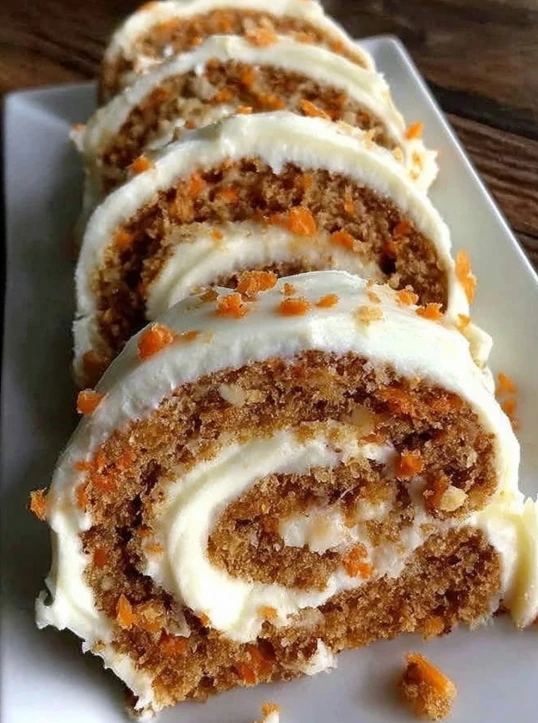
In the high-stakes discipline of pastry engineering, the “Carrot Cake Roll” represents a masterclass in Flexible Matrix Structural Design. Unlike a traditional tiered cake, which relies on vertical load-bearing strength, a cake roll requires Tensile Elasticity and Structural Pliability. We are engineering a delicate crumb that must withstand a 180-degree radial bend without undergoing catastrophic mechanical failure (cracking).
Project Specifications
The success of this build is entirely dependent on the “Thermal Window”—the brief period where the cake’s starch structure is set but still retains enough moisture to be manipulated into a coil.
- Prep Time: 30 Minutes
- Inactive Time: 2 Hours (Thermal Stabilization & Setting)
- Cook Time: 12–15 Minutes
- Total Time: 2 Hours 45 Minutes
- Servings: 10–12 Slices (Cross-Sectional Modules)
Detailed Cost Estimate (USD)
| Cost Driver | Role | Est. Cost |
|---|---|---|
| Organic Carrots (Finely Grated) | Internal Moisture Reservoirs | $1.50 |
| High-Fat Cream Cheese (8oz) | Viscous Core Matrix | $2.50 |
| Large Eggs (3-4 Units) | Protein Scaffold & Aeration | $1.00 |
| Warm Spices (Cinnamon/Nutmeg) | Volatile Flavor Modifiers | $0.50 |
| Total Estimated Cost | $5.50 | |
The Ingredient Architecture
The Flexible Starch Foundation
0.75 Cup All-Purpose Flour & 1 tsp Baking Powder: A low-volume starch profile is used to keep the crumb light. The baking powder provides the Gas-Phase Expansion necessary for a sponge-like cellular structure.
The Moisture Reservoirs
2 Cups Finely Grated Carrots: Carrots provide Hygroscopic Stability. As they cook, they release moisture into the surrounding starch, preventing the cake from becoming brittle during the rolling phase.
The Protein Scaffold
Whisked Eggs & Sugar: Beating the eggs to the “ribbon stage” incorporates air, creating a Leavened Foam. This protein network provides the primary structural support for the carrots and flour.
The Viscous Core (The Filling)
Cream Cheese, Butter, and Powdered Sugar: A high-fat emulsion. The cream cheese must be Tempered to 21°C to ensure a smooth, spreadable consistency that bonds to the internal cake surface without causing structural tearing.
The Phase-Based Workflow
Phase 1: Foam Stabilization & Baking
Incorporate the dry starch into the egg-sugar foam. Fold in the carrots. Spread the matrix onto a parchment-lined jelly roll pan. Bake at 190°C (375°F) for 12–15 minutes.
The Science: We are inducing Protein Denaturing. The heat causes the egg proteins to uncoil and bond, trapping the CO2 bubbles. Simultaneously, the Starch Gelatinization sets the crumb, while the carrots prevent the matrix from over-drying through localized steam release.
Phase 2: Immediate Mechanical Pre-Stressing
While the cake is at peak thermal energy, flip it onto a towel dusted with powdered sugar and roll it into a tight cylinder. Allow it to reach Thermal Equilibrium (cool completely) in this position.
The Logic: This is Molecular Memory Formation. By rolling the cake while warm, we set the starch chains and protein fibers in a curved orientation. If allowed to cool flat, any subsequent attempt to roll would exceed the crumb’s Elastic Limit, causing the cake to fracture.
Phase 3: Core Emulsion Application
Carefully unroll the cooled cake. Apply the cream cheese matrix in a uniform 0.5cm layer. Re-roll the cake without the towel.
Phase 4: Structural Stabilization
Wrap the completed cylinder in plastic film and refrigerate at 4°C (40°F) for 1-2 hours.
The Science: This phase allows for Lipid Re-solidification. The fats in the cream cheese and butter firm up, acting as a “structural grout” that holds the spiral shape together. It also allows for Moisture Migration, where the frosting slightly hydrates the inner surface of the cake for a unified bite.
Resting & Servicing
Extract from the cold-chain and remove the film. Use a Serrated Mechanical Saw (bread knife) for portioning.
The Logic: A serrated blade uses a sawing motion rather than downward pressure. This prevents Compressive Deformation, ensuring the circular geometry of each slice remains intact and the viscous core doesn’t squeeze out of the sides.
Final Service: Dust with a final layer of powdered sugar for visual High-Contrast Aesthetics. Serve at 15°C (59°F) to ensure the filling is firm enough for a clean cut but soft enough for optimal flavor release.