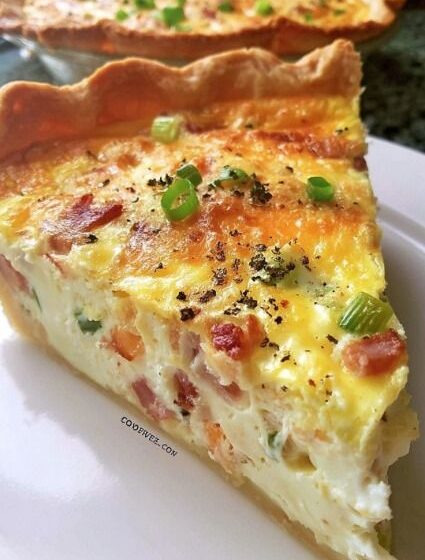
In the architectural hierarchy of brunch, the Quiche stands as a premier load-bearing structure. Often misunderstood as a mere “egg pie,” a truly engineered quiche is a study in colloidal stability and lipid-flaked crust integrity. We are not merely baking; we are managing the suspension of solids within a delicate, thermally-set protein matrix.
## Project Specifications
Success in this build requires strict adherence to the thermal timeline. The “Inactive Time” is the most critical phase, ensuring the structural stability of the pastry housing.
- Prep Time: 30 Minutes
- Inactive Time (Chilling & Blind Baking): 1 Hour 30 Minutes
- Cook Time: 45–50 Minutes
- Total Time: 2 Hours 45 Minutes
- Servings: 8 Units (Slices)
### Detailed Cost Estimate (USD)
| Cost Driver | Role | Est. Cost |
|---|---|---|
| High-Fat European Butter | Shortening Agent (Crust) | $2.50 |
| Organic Heavy Cream & Eggs | The Protein Matrix | $4.00 |
| Pancetta or Smoked Bacon | The Umami Matrix | $5.50 |
| Gruyère AOP | Flavor & Texture Binder | $6.00 |
| Total Estimated Cost | $18.00 | |
## The Ingredient Architecture
### The Lipid-Starch Foundation (Pâte Brisée)
250g All-Purpose Flour, 150g Cold Butter, 1 Egg Yolk: This is our “containment vessel.” The goal is a high degree of shortness—where butter inhibits long-chain gluten development.
### The Custard Suspension (The Core)
4 Large Eggs + 2 Cups Heavy Cream: A strictly calculated 1:2 ratio of egg to dairy. This ensures a silken, “set” texture rather than a rubbery, sulfurous scramble.
### The Aromatic Trinity
Leeks, Shallots, and Fresh Thyme: These provide the volatile organic compounds (VOCs) that bridge the gap between the heavy lipids and the neutral starch.
### The Umami Matrix
150g Sautéed Pancetta & 1 cup Grated Gruyère: These components provide the salt-forward base and the internal structural scaffolding as the custard sets.
## The Phase-Based Workflow
### Phase 1: Lipid Lamination and Crust Hardening
Pulse cold butter into flour until pea-sized nodules form. Add ice water (sparingly) until a shaggy mass forms. Chill for 60 minutes at 4°C (40°F).
The Science: This is “Solid-State Fat Distribution.” By keeping the butter cold, it remains a solid until it hits the oven. When it eventually melts, it leaves behind air pockets, creating the desired “flaky” mechanical property via steam expansion.
### Phase 2: Blind Baking (Structural Pre-Heat)
Roll the dough, fit to a 9-inch tart pan, and fill with ceramic weights. Bake at 190°C (375°F) for 15 minutes, then remove weights and bake for 5 more.
The Logic: This prevents the “Soggy Bottom Syndrome.” Pre-cooking the starch allows it to undergo Amylose Crystallization, forming a waterproof barrier before the liquid custard is introduced.
### Phase 3: Matrix Emulsification
Whisk eggs and cream with 1/2 tsp Nutmeg. Nutmeg is a chemical enhancer that interacts with the dairy fats to deepen the perceived richness.
### Phase 4: Thermal Coagulation
Layer the sautéed aromatics and cheese in the pre-baked shell. Pour the custard over the top. Reduce oven to 160°C (325°F) and bake for 45-50 minutes until the center registers 77°C (170°F).
The Science: We are looking for Protein Denaturing. High heat causes egg proteins to bond too tightly, squeezing out moisture (syneresis). By using a lower temperature, we allow the proteins to form a soft, interconnected web that traps the cream in a delicate gel.
## Resting & Servicing
The quiche must remain in “Structural Stasis” for at least 20 minutes post-extraction. Cutting too early will lead to Hydraulic Collapse.
The Science: During the resting phase, the internal temperature continues to equalize (carry-over cooking). The custard undergoes Final Gelation, increasing its shear strength so it can support its own weight when sliced.
Final Service: Serve at Room Temperature. Cold temperatures mute the volatile aromas of the Gruyère, while excessive heat masks the subtle sweetness of the cream.