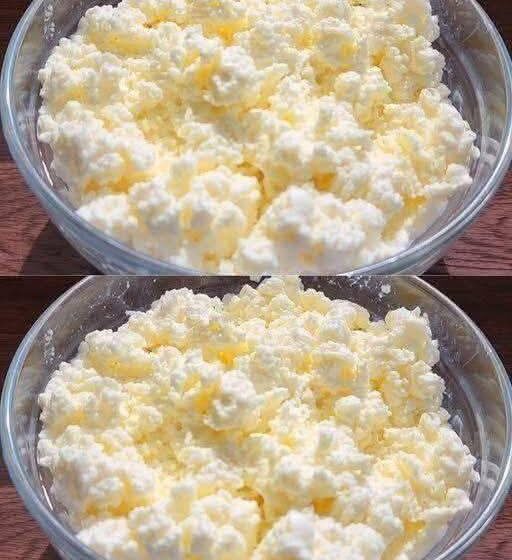
Farmer’s Cheese (also known as Pot Cheese or Queso Blanco in similar structural variants) is the foundational project of Dairy Engineering. Unlike aged cheeses that require microbial rennet and months of maturation, Farmer’s Cheese relies on Isoelectric Precipitation. By introducing a food-grade acid to heated bovine lipids and proteins, we shift the pH of the milk, causing the negatively charged casein micelles to lose their repulsive force and aggregate into a solid structural matrix (the curd), separating from the liquid byproduct (the whey).
1. Project Specifications
- Prep Time: 10 minutes (Equipment Setup).
- Active Cook Time: 20–30 minutes (Thermal Induction).
- Inactive Set/Strain Time: 30 minutes (Soft) to 4 hours (Firm/Sliceable).
- Total Time: Approximately 1 to 5 hours.
- Servings: Yields approximately 12–16 oz (340–450g) of cheese.
- Estimated Cost:$5.00 – $8.00 USD.
- Cost Drivers: High-quality Whole Milk ($4–$6), Lemon Juice or Vinegar ($1), and high-density Cheesecloth.
2. The Ingredients
The Protein-Lipid Source:
- 1 Gallon (3.8L) Whole Milk: Must be “Pasteurized” but NOT “Ultra-Pasteurized” (UHT).
- The Science: UHT milk has undergone extreme thermal stress, which denatures the lactobumin and prevents the proteins from forming a stable curd lattice.
- 1 cup Heavy Cream (Optional): To increase the lipid-to-protein ratio, resulting in a “Creamier” finish.
The Coagulating Catalyst:
- ½ cup Acidulent: Distilled White Vinegar or Freshly Squeezed Lemon Juice.
- The Logic: Vinegar yields a neutral, clean finish; Lemon Juice adds a subtle citric brightness and a softer curd set.
The Flavor Stabilizer:
- 1 tsp Kosher Salt: Added post-separation to enhance flavor and aid in further moisture expulsion through osmosis.
3. Engineering Phase 1: Thermal Denaturation
The objective is to heat the milk to the precise point where proteins are agitated but not scorched.
- The Process: Pour the milk into a heavy-bottomed stainless steel pot. Heat slowly over medium heat, stirring constantly to prevent Maillard browning (scorching) at the base.
- The Target: Heat to 190°F (88°C). At this temperature, the whey proteins begin to unfold, preparing to bond with the casein once the acid is introduced. You will see small bubbles (foaming) around the edges, but do not allow a rolling boil.
4. Engineering Phase 2: Acid-Induced Flocculation
Once the thermal target is achieved, remove the pot from the heat source. This is the Phase-Shift moment.
- The Injection: Pour in the acid (vinegar or lemon juice) slowly while stirring gently.
- The Science: You are lowering the pH of the milk toward its isoelectric point (pH 4.6). As the acidity increases, the calcium phosphate that holds casein micelles together dissolves, and the proteins “clump” together.
- The Logic: Let the mixture sit undisturbed for 10–15 minutes. You should see a clear separation: solid white “curds” floating in a translucent, yellowish-green liquid known as “whey.”
5. Phase 3: Hydrostatic Filtration (The Strain)
To transform the “slurry” into “cheese,” we must remove the excess hydration through gravitational filtration.
- The Mechanical Setup: Line a large colander with four layers of fine-mesh cheesecloth. Place the colander over a deep bowl or sink.
- The Pour: Carefully ladle the curds into the cloth. Let the whey drain naturally for 5–10 minutes.
- The Compression: Gather the corners of the cheesecloth and tie them together. Hang the bundle over a sink or a bowl.
6. Phase 4: Density Optimization
The final texture of your Farmer’s Cheese is determined by the duration of the Gravitational Set.
- Soft/Spreadable (30–60 mins): High moisture retention. Ideal for spreads or folding into blintzes.
- Firm/Sliceable (2–4 hours): Low moisture retention. At this stage, you may place a weighted plate on top of the cheese bundle to force out more whey.
- The Seasoning: Once the desired density is reached, transfer the curds to a bowl and fold in the salt. This is also the time to add herbs like dill or chives.
7. Resting and Servicing Protocol
Mandatory Cooling Period: 1 hour in the refrigerator.
- The Result: Cooling allows the fats to solidify and the protein matrix to tighten, making the cheese easier to crumble or slice.
- High-Value Pairing: Serve on Toasted Sourdough with a drizzle of Truffle Honey and cracked black pepper. The sweetness of the honey provides a chemical “bridge” to the mild acidity of the cheese, while the sourdough offers a fermented, crunchy contrast to the creamy curds.